Doing Time…

thakuma

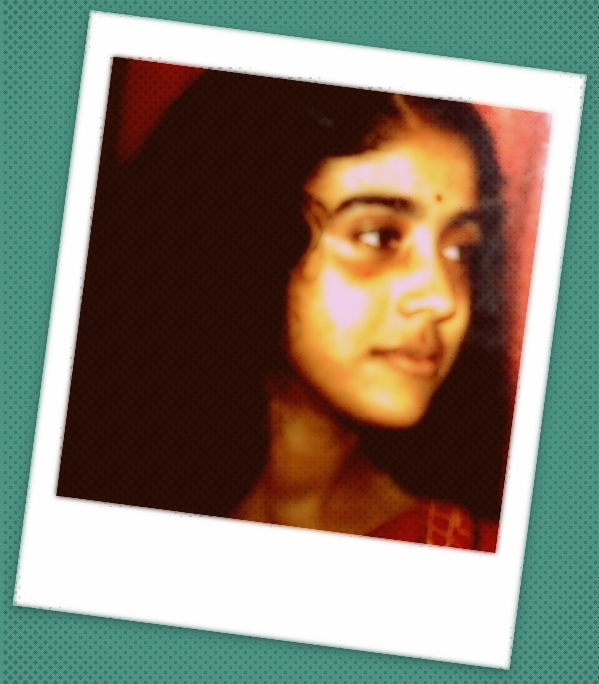
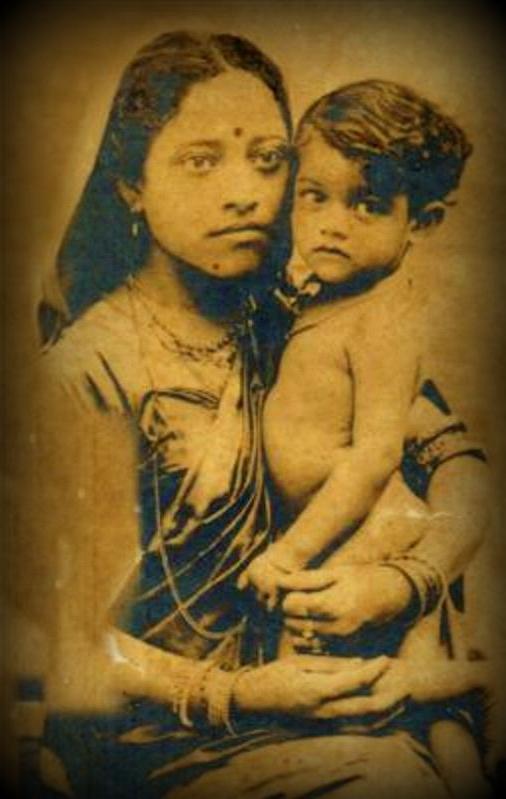
‘Once upon a time…’  holds promises that didn’t lend themselves to the  birth of Labanya L, born the fifth daughter (in lieu of…)to  a conservative Brahmin mathematician and his nearly illiterate wife.  The Brahmin was handsome. The wife was not.  Labanya L  picked up bits and pieces of both and blossomed into a girl not-quite-not pretty. There was a strangeness about her sepia eyes that stood out in stark contrast to her very dark complexion, and the reddish brown curls that fell flippantly on her small forehead became her porcelain sisters a lot more. The father was lost in the metaphysics of numbers. The mother wept when new born Labanya L was brought to her.
The sisters turned heads and changed hands like magic by the time they were twelve. Labanya grew darker and older and was wedded to numbers and obsessed with Bankim Babu’s novels. Things happened in that world. Beautiful princesses fell in love with middle aged Kings and made them their own.  Pretty young wives stayed hopelessly in love with decrepit husbands; blind girls found love. And vision.

Caught in the twilit zone of illusion and reality,  the  Dark Duckling developed a strange passion for a man who was twenty five years ahead of her, married, with two kids and a third on the way; she was thirteen ; he, thirty eight.  She was silent and observant, and each day waited for the middle aged lawyer to show up at her father’s outer chamber for manly conversations almost every evening; the man did strange things to the girl’s fluttering heart and opened up forbidden vistas.  Then, destiny struck and the sickly wife died three months after giving birth to the third child.
As  Labanya L was a girl of numbers and the only one who could take on the mathematician in complicated debates on the epics, one fine morning she walked into her father’s room, tossed her wild mane  and told him that she wanted to marry his friend. She was fourteen; he, thirty nine. The mother wailed. The father fell silent. Labanya L continued to meet their eyes till the war was over on the third day. The conservative mathematician drew his illiterate wife to a side and told her that the girl was a ‘swayamvara’ and therefore, not to be offered to any other man; that would be sin. Having found a mythical justification for the waywardness of his daughter, he wore his wooden sandals, and showed up at his friend’s house to offer Labnya L in marriage.  The middle aged lawyer stared in disbelief and broke out into a guffaw that filled the room (he was famous for his roars). He tried to convince the Mathematician that Labanya L was a dark Lotus and would soon find herself a prince.  The Mathematician repeated what he had told his wife: Shastras were not to be flirted with, nor divine dispensation.

So one day,  she of the sepia eyes and red curls found herself   in the large sprawling courtyard of the father’s friend, as the ‘new’ bride, the ‘Naya Khurima’ as the nephews and nieces of that large family would call her. The step daughter welcomed her with an open smile for she needed someone to play hopscotch with. Besides, who would be scared of a mother who was two years and some  younger? The elder son turned away confused, not knowing how to react to a mere girl who would soon replace his mother in his father’s life. The wailing infant of course had no choice as he was shunted to an unfamiliar lap that would cradle him to his toddling years and hold him firmly the rest of his life.
While the bemused women of the family waited and watched to see how the strange drama unfurled, Labanay L geared herself up for difficult conquests: she treaded on hostility, ignored cruelties and protected her husband from the hurts of the big, bad world that found him guilty of unnatural passions at the ripe old age of thirty nine!  She rejected colors, deciding to drape herself in plain white saris with red border, found a match for the sister-daughter and   initiated herself into womanhood. She meant business. Sons came her way and a daughter almost every alternate year.  All grew up knowing that theirs was a strange destiny, in which a mother’s affection was meant to be only a hurried, furtive hug in the dark nooks of the family fortress when no one was looking. They accepted the distance and the detachment as a definition of maternal comportment and took refuge in the uncomplicated, effusive affection of a father who was as confused as his own flesh and blood by the mysterious ways of a girl-woman who had made him her own without his consent.
Labanya L’s baffled, throttled womanhood   invented ways of keeping the emotional and the physical two disjointed spheres; in a world in which she slept with her husband every night with the former wife glaring at her out of an oversized garlanded frame, she was scared of loving her own blood lest the world found her guilty for not loving the not-her-own.

She devised a strange strategy and redefined her gestures as an epic of consumption. That was the only sphere where she was allowed to love her fifty some husband (her youngest was born when she was twenty five), shower affection on her own children and not be judged for it. Cooking was the world where she felt safe. Not judged. Not found guilty of misdemeanor.  She churned milk that was brought in daily in a huge clay pitcher from the family cowshed everyday to make fresh butter to be delivered straight to the traditional brass plate of the husband before he left for the district court. (whatever was left went towards…),Cooked fish with strange combinations of fenugreek and fennel pastes for the  daughter who declared herself stranger to vegetables early in life; made ‘taktis’, sweets with cream jaggery and fresh coconut for the sons who cared nothing for anything and everything that floated in gravies and curries; made  kheers with over ripe jackfruits that dropped off from the trees  when their hour arrived;  her reputation as a cook grew and palanquins from neighborhoods and other villages arrived to take her  as the Reverend Chef to supervise the making of traditional feasts for marriages and sacred thread ceremonies. Her fatal flaw was ghee; her aberration was turmeric; she refused to touch meat; Sweets were her forte, but not part of her own consumption tale.  None fathomed that cooking was her way of loving and living and that is precisely why she perfected the art, why she stopped when such gestures became redundant.

As other women came into the sons’ lives, she quietly passed on her culinary mantras to them with the same aloof-detached way that the Man in her life could never accurately translate.  Paanch Phoron and mustard oil for tempering for chutneys; Pineapples were special: they merited ghee and fenugreek; rice had to be sautéed in ghee before getting added to the creamy base for Payesh; make a paste of raisins to add to meat and fish ‘Kaliyas’ for that special color and flavor; but of course the amount of rice for ‘khichuri’ should be a third less than the lentils…
As time passed, granddaughters arrived and became awestruck listeners to these tales imparted by their mothers; Labanya L never concurred. She battled the pony-tails with a mysterious smile… but of course she has forgotten the recipes… why don’t they go and ask their mothers?

She was not good at elucidations.
She never told the world that she was born Labanya Lata.
The youngest Daughter -in -law found it out by accident. She was let into the terrible secret by her Grand -mother in law (the poor woman was scared of her dark daughter too): “didn’t you know, Her Royal Highness was a ‘…Lata’ before she ensnared your poor Pa-in-law; he transformed her into “Prabha”, the Light of his life!”

Labanya  Prabha knew that was not a story to pass on.
A Sometimes Woman

Image

Amounts…proportions… spices and a nonagenarian aunt (does one even use that word anymore?) how does one string all of those words together into a narrative?

A dim lit corridor, sooty stain glass windows creating strange patterns on faces, hers and mine, especially on hers, as she walks up to greet a stranger that once was her niece. A silk scarf tied neatly under her chin (it is winter, remember?) and a strange incongruous snazzy sweater, possibly a gift from the youngest American sibling, who too has lost the sense of time.

Her eyes had no light. Remembering was an art she had given up.

–“How can I help you?”

She couldn’t. I had come in search of an attic, and a terrace, where discarded bath tubs grew surreal Rajanigandhas that cast a spell on starry nights and an aunt hijacked a child to a shadowy nook ,stroked her hair, looked furtively around and sang to the girl, in a lyrical-furtive voice, a Tagore number that urged the flowers to shower their fragrance, for the moon was luscious too! The child would stare at the secretive musical face and understand that this song was strictly for her.

Hush!

The world shouldn’t know that she sang. The world shouldn’t know that she was capable of strange passions. Pull your thick, lovely hair back and tie all of it into an unkempt bun so that your eyes don’t look like two shaded pools. Wear no color. No bangles. Not even on the occasions of the younger sisters’ weddings. She had five.

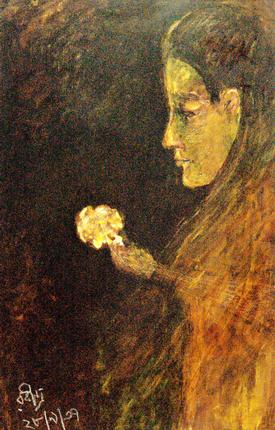
She was a sometimes-woman.

When she sang to her four year old niece.

When “Chhenu mama”, her father’s once legal junior made his fortnightly visit to the house, sporting a shamefaced smile and a pipe, which would disappear as soon as he entered Dida, my Grand mother’s room, where the Grand dame held court for one and all.

The sometimes-woman would glide to the pantry and bring out a dainty pair of antic porcelain cup and saucer, to serve orange –red Darjeeling tea that filled the room with its untimely aroma. Chhenu mama usually arrived quite late, after the day’s battle at the Court. So he had to consume two toasts lavishly buttered under the strict supervision of the sometimes woman, and beamed despite protestations.

Marriage was a possibility once upon a time, but time was not propitious. The eldest daughter had to be married first; the second was, after all, the second. So in a very befitting masculine sort of way he moved on …gave it a shot, as they say, and returned hurt, single, with two children, to the toast and the tea. No questions asked. The two formed a magical open-close sphere which accommodated gestures, togetherness, and commitments beyond convention. The Grand dame acquiesced, so did the siblings. So when the niece spotted the two together in a cinema hall and pointed them out to her mother, the mother covered the chirping six-year-old mouth with her hand: “Look away…Don’t disturb them.”

Nobody knew why she never yielded to the man, who virtually waited an entire life for her forgiveness.

Nobody knew why she took all her younger siblings under her wings after the untimely death of her father, only to hurt them later in a way that made them turn away from her;

Nobody cared that her eyes were  lovely and tender. Once.

Amounts…proportions…life wasn’t like that in her book of definitions. Nor was cooking. With a disdain for the commonplace, she cooked her Biryanis and Kormas and Kaliyas with a gay abandon, curling up her lips at the slightest suggestion of measuring cups.  Sometimes she got adventurous and the dishes would not have any names. Cooking was about defying conventions. So was life!

But what would I know about that, I, who continue to measure my life with a coffee spoon.

Chota Amma

Image

Negotiating a new life isn’t easy,   especially when you find yourself being driven down from the station in a jeep that raised red dust and pulled up suddenly in front of a mansion that wore the distinct look of a haunted house. Except, it had a lovely rose garden that was concealed from your view by the exposed, barren front entrance and a rickety gate. Except three dark smiling faces who welcomed you and were introduced to you as “Your Out-house Servants”. You were young, remember? Fresh out of a campus that taught class privilege was a sin.  Naming was a trial too. That was part of the negotiation. You were the DAO’s wife.  —Memsaab.  The Saab was uneasy in his garb as well, and took to smoking pipe to prove to the world that ..but that is another story.


                  Mornings were inviting …the sky that was a canvas through the French windows, and the maalis ,hunched on the green grass in the garden, tending to the roses,  mingled with the Darjeeling tea that was brought to you by the Telugu Bai on a Kashmiri tray, a lovely hue and smoke emanating from the bone china mugs with faint floral patterns on them. Pink.Green. That you bought them from an Auction House on Park Street was a secret to the smiling Bai. She beamed, for she was in touch with greatness.


Afternoons simply were. The kitchen was not your territory, certainly not for long! : “Memsaab log khaana nehin pakaata; filom dekhta;  kilub jaata” , was the Bai’s expert advice to the memsaab whom she found hopelessly ‘chota’ and completely unprepared for the greatness that was thrust on her. So  at an auspicious hour she walked up to you and told you with an open smile that from that day she would call you :”Chota Amma”in her singsong  Telugu Hindi for you were (or so she suspected) younger than her ‘larki’.  While  you negotiated, adjusted yourself  to your chameleon identity,  Mrs DAO/ DAO Memsaab/ Chota Amma, lazy afternoons became training sessions  for the Queen and the maid. The Queen on her bed, the maid on the floor. The spatial politics was a mockery, naturally. The maid taught the Queen the intricacies of mutton curry cooked with tamarind and curry leaves, the magical fermentation of urid daal and parboiled rice, the occult science of making curd  that was not smelly and pungent, in a bowl.Kancheepurams were part of the training too and (a furtive glance around to see whether or not the badmaash bungalow peon was eavesdropping) the maid would suddenly drop her voice: do not encourage ‘Essistant Engine Saab… there was an odd look in his eyes when Saab  brought him home for tea! such bad bad men Saab brings to the house, ….


 Above the antique mantel was displayed

 As though a window gave upon the sylvan scene

 The change of Philomel, by the barbarous king

 Filled all the desert with inviolable voice

 And still she cried, and still the world pursues,

 “Jug Jug” to dirty ears.


So you listened. You learned all about Rava Dosas, Upmas, Uttapams, voyeuristic transgressions, as the afternoon sun drooped on the lonesome highway that led to Kharagpur  IIT. Time for the Saab to return home.  Time for the bungalow  peon to start the water …arrange puri sabzi/ chicken sandwiches on the tray and take a peek out of the kitchen window to watch out for the Jeep that shall bring the pipe smoking King home.  

 Five O’ clock. Officers were gentlemen; they came home at five sharp; never drank tea after sundown. Were to be found preferably at the club, guffawing , or playing Tennis, or doing both.


“What shall I do now? What shall I do?

I shall rush out as I am, and walk the street

With my hair down, so. What shall we do to-morrow?

What shall we ever do?”

 The hot water at ten.

And if it rains, a closed car at four.

And we shall play a game of chess,

Pressing lidless eyes and waiting for a knock upon the door.


At the club, the ladies drank over sweetened milky tea and crunchy onion pakoras, played housie, laid bare their men and marital intricacies to each other. You cringed. For you were taught what happened between a man and a woman was stuff for heightened narration, even  in a fallen state:  Madame Bovary… Madame Karenina… so you turn away and walk up furtively to the smoking room  and make a gesture… you take a deep breath in the darkness as strange fragrance oozes from the banyan trees lining up the avenue of what was once the European Colony.


HURRY UP PLEASE ITS TIME


HURRY UP PLEASE ITS TIME


                 Tomorrow is another day. Tomorrow is other negotiations…


                                                                                  *****

Negotiating a life isn’t difficult either. But that is something you learn later, especially as things start to fall into place, like a jigsaw puzzle, like a Rubik cube or a tangent metaphor and suddenly  life isn’t a hieroglyphic anymore!  The DRM’s Bungalow is more spacious. Mrs Chopra prefers to make Dum Aloo for Kitty Parties; Mr Nagpal is allergic to prawn; Rum is to be bought only from Kalaikunda Army Canteen; Prafulla, Mrs Mishra’s Bungalow peon has to be brought in if you’re throwing a party for the engineers on training (How they eat, Ammaaaaaa);  Chief Medical Officer’s wife throws all formalities to the wind and openly addresses you as ‘Bou-ma’  much to the chagrin of the Duchesses around.   Meat achaar, mango pickles, soft unsalted butter wrapped in a plantain leaf, Chandrama , the Bai.. Afsha Ahmad from Lucknow and her effortless Biryanis, the earthy green curtains bought from Jhargram Cooperative , the Maruti Gypsy of the Engineering Department, Winnie Court.. all seep into you, arrange and unfurl into a many splendored thing inside you  and become a philosophy in a strange way, beyond regrets, beyond a sense of loss: there is  Neelachal Express…there is Godfrey Mansion  .. . there is Chandrama and Mr. Gopal Krishnan,  and there is, above all, ‘Chota Amma’ who is yet to become a mother…