Amounts…proportions… spices and a nonagenarian aunt (does one even use that word anymore?) how does one string all of those words together into a narrative?
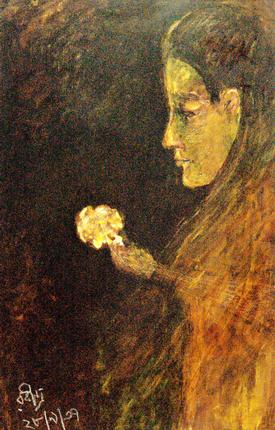
A dim lit corridor, sooty stain glass windows creating strange patterns on faces, hers and mine, especially on hers, as she walks up to greet a stranger that once was her niece. A silk scarf tied neatly under her chin (it is winter, remember?) and a strange incongruous snazzy sweater, possibly a gift from the youngest American sibling, who too has lost the sense of time.
Her eyes had no light. Remembering was an art she had given up.
–“How can I help you?”
She couldn’t. I had come in search of an attic, and a terrace, where discarded bath tubs grew surreal Rajanigandhas that cast a spell on starry nights and an aunt hijacked a child to a shadowy nook ,stroked her hair, looked furtively around and sang to the girl, in a lyrical-furtive voice, a Tagore number that urged the flowers to shower their fragrance, for the moon was luscious too! The child would stare at the secretive musical face and understand that this song was strictly for her.
Hush!
The world shouldn’t know that she sang. The world shouldn’t know that she was capable of strange passions. Pull your thick, lovely hair back and tie all of it into an unkempt bun so that your eyes don’t look like two shaded pools. Wear no color. No bangles. Not even on the occasions of the younger sisters’ weddings. She had five.
She was a sometimes-woman.
When she sang to her four year old niece.
When “Chhenu mama”, her father’s once legal junior made his fortnightly visit to the house, sporting a shamefaced smile and a pipe, which would disappear as soon as he entered Dida, my Grand mother’s room, where the Grand dame held court for one and all.

The sometimes-woman would glide to the pantry and bring out a dainty pair of antic porcelain cup and saucer, to serve orange –red Darjeeling tea that filled the room with its untimely aroma. Chhenu mama usually arrived quite late, after the day’s battle at the Court. So he had to consume two toasts lavishly buttered under the strict supervision of the sometimes woman, and beamed despite protestations.
Marriage was a possibility once upon a time, but time was not propitious. The eldest daughter had to be married first; the second was, after all, the second. So in a very befitting masculine sort of way he moved on …gave it a shot, as they say, and returned hurt, single, with two children, to the toast and the tea. No questions asked. The two formed a magical open-close sphere which accommodated gestures, togetherness, and commitments beyond convention. The Grand dame acquiesced, so did the siblings. So when the niece spotted the two together in a cinema hall and pointed them out to her mother, the mother covered the chirping six-year-old mouth with her hand: “Look away…Don’t disturb them.”
Nobody knew why she never yielded to the man, who virtually waited an entire life for her forgiveness.
Nobody knew why she took all her younger siblings under her wings after the untimely death of her father, only to hurt them later in a way that made them turn away from her;
Nobody cared that her eyes were lovely and tender. Once.
Amounts…proportions…life wasn’t like that in her book of definitions. Nor was cooking. With a disdain for the commonplace, she cooked her Biryanis and Kormas and Kaliyas with a gay abandon, curling up her lips at the slightest suggestion of measuring cups. Sometimes she got adventurous and the dishes would not have any names. Cooking was about defying conventions. So was life!
But what would I know about that, I, who continue to measure my life with a coffee spoon.
 Methinks...
What a way to meet your blog for the first time! Lovely!
Ruma: finally we meet in our chosen terrain!
We do! 🙂
you too dont measure life in a coffee-spoon! Your writings have an abondon , spicy and heady all at once.
Humbled, Pampa!
Vividly written, a real treat, will read through the rest of your blog. With your permission of course.
Achyut Dutt, I have just started… there has been just one more previous to this… and yes, I am touched that you like it !
Lovely. I was happy to note that I had detected an Eliot flavour in the first story I read. Shows I am old but not gone gaga. Frankly, I like this style, these subjects, more the ones that occupy you nowadays. This is right up my alley. By the way, you reminded me also of Miss Havisham, don’t know exactly why. But I was glad for this Miss Havisham, for obvious reasons. Will read more of this blog. Not for too long I suppose, since you have given it up. Like it or not, I am not too fond of the Bengali subject I had started to read and this had nothing to do with not reading it serially. Nothing good or bad about it. People are people.
True that. Each to his taste.